DealScope — Buyer Intelligence Engine
The Problem
On a sell-side mandate, the buyer list is the deliverable that decides every other one. Which names get called in the first two weeks determines how much competitive tension the process generates — and competitive tension is what moves valuation. Yet at most advisory firms the list is still built by hand: analysts spend days combing databases, cross-referencing deal histories, and judging appetite from memory. The output is a static Excel sheet that treats a serial acquirer with dry powder the same as a strategic who takes meetings and never transacts — nothing in it measures how likely each buyer is to actually do the deal.
Why It Matters Commercially
The analyst hours are the visible cost. The larger cost is fee revenue: in a success-fee business, a process that stalls because the right buyer sat at number 40 on a list of 200 — and never got a call — is months of work with nothing to invoice. Sell-side advisory is also a race. Rival advisors are often calling the same buyers, and the firm that reaches the right one first, with a credible angle, usually wins the process.
What We Built
A buyer intelligence engine built around the sell-side workflow. An analyst loads a live mandate — target profile, sector, financials, deal parameters — and the system ranks the buyer universe by likelihood to transact, with the reasoning attached.
The core is a machine learning model trained on the client's own acquisition history: it learned the patterns that separate buyers who close from buyers who circle, at a given check size, sector, and multiple.
For every buyer on the list, the system produces:
- •A composite fit score across the dimensions a banker actually weighs: sector alignment, check-size fit, deal history, strategic rationale, and execution complexity
- •The reasoning in plain language — a narrative an MD can read, challenge, and defend to a client, not a black-box number
- •Watchouts flagged up front: gaps in financial data, valuation mismatches, and execution risks that would otherwise surface mid-diligence
- •A recommended next action — prioritize outreach, hold for more data, or deprioritize — so the list converts directly into a calling plan
- •A tailored outreach angle built from the target's actual financials and growth profile, matched to the buyer's known acquisition preferences
- •Full deal history — prior transactions, deal values, multiples paid, deal types — pulled and structured automatically
None of this replaces the banker's judgment. It replaces the blank spreadsheet that judgment used to start from — so the first call goes to the most probable buyer, not the most familiar name.
Outcome
Analyst time on buyer list construction drops from days to hours. The top of the ranked list reflects buyers who actually transact, not buyers who look good on paper. Over a quarter, the team makes earlier calls to the right buyers on more mandates. That speed advantage compounds into closed deals.
Where This Pattern Applies
The pattern fits any business that works a long list where the calling order decides revenue. Placement agents ranking hundreds of LPs for a fundraise. Corporate development teams screening acquisition targets. Commercial real estate capital markets desks matching assets to the buyers most likely to bid. Debt advisors deciding which lenders see a deal first. In each case, the firm's own transaction history already holds the signal — it has just never been turned into a ranking with reasons attached.
See It in Action
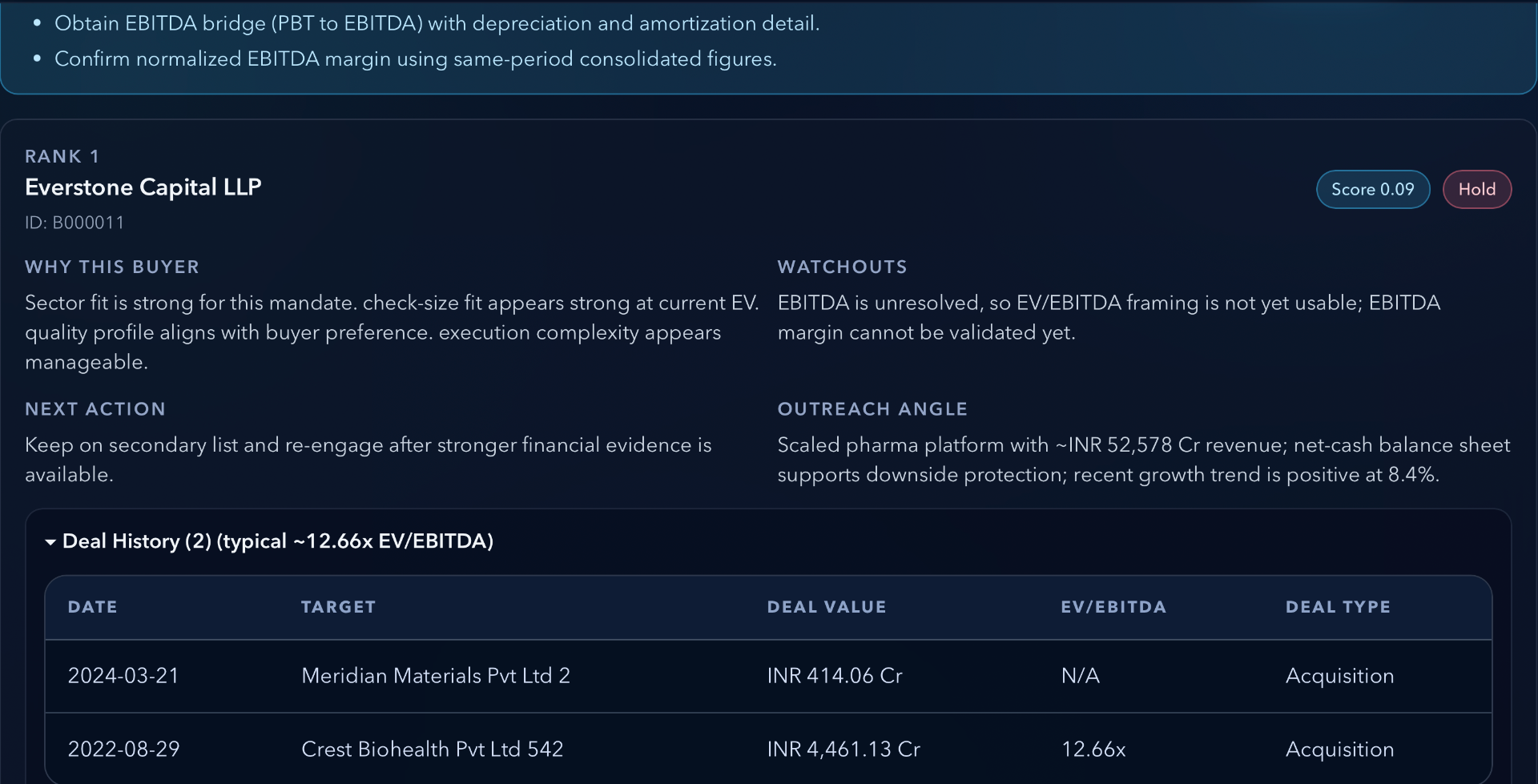
Scored buyer shortlist for an India-based pharma sell-side mandate, with Everstone Capital ranked as a top buyer — including the full reasoning chain, watchouts, outreach angle, and historical deal comps at ~12.66x EV/EBITDA.
Still building the buyer list by hand?
We can assess how your mandate flow and transaction history could support a ranked, reasoned buyer process — and build the system that runs it.
Explore a Similar System