Insurance Client Risk Dashboard
The Problem
Insurance operations teams find out which clients are trouble after the trouble starts. The client likely to file a high-cost claim, cancel mid-term, or dispute coverage usually signals it at intake — but the signals sit scattered across forms, call notes, and payment preferences that nobody reads together. Underwriting prices the policy risk; no one scores the operational risk: which clients will consume disproportionate service effort, which are likely to churn, and which need intervention before renewal becomes a negotiation.
Why It Matters Commercially
A book of business does not cost the same to service per client, and the spread is wide. High-maintenance clients absorb ops hours without paying more premium for them, mid-term cancellations unwind acquisition cost that has already been spent, and retention effort lands wherever a manager's gut says — which means its quality depends on who is working that day. Knowing at intake where the servicing cost and churn risk sit is the difference between managing a portfolio and reacting to it.
What We Built
A risk scoring dashboard that evaluates every client at intake, before the servicing relationship begins, and shows the ops team where attention will be needed.
The system provides:
- •A 0–100 risk score and severity level — Low, High, or Critical — for every client, visible in a single list view
- •Factor breakdowns behind every score: "Immediate urgency correlates with higher risk: +15," "Cash payment preference shows higher cancellation risk: +12," "Prior insurance experience reduces risk: -12"
- •Direction and magnitude on each factor, so a manager can see exactly what is driving a Critical score and choose a proportionate intervention
- •The full book sorted and scored, so the day gets triaged around the clients who actually need it
A score of 84 means nothing on its own. A score of 84 driven by "cash payment preference +12, immediate urgency +15, no prior coverage +10" tells the team what kind of risk this is — and what to do about it.
The factors shown come from the demonstration model. In a deployment, scoring criteria are selected with the client and reviewed against the regulatory and fairness standards that apply to their lines of business.
Outcome
Agents and producers know where to spend their time. The clients flagged Critical tend to consume the most service hours and renew the least; concentrating effort on the rest of the book pays off in both retention and commissions.
Where This Pattern Applies
Intake-time scoring with explained factors transfers to any business that takes on long-lived customer relationships with uneven servicing costs. Lenders flagging borrowers likely to need collections attention. Property managers screening tenants beyond the credit check. Subscription businesses spotting churn risk at signup rather than at cancellation. B2B firms scoring new accounts for support load before pricing renewals. The factors are learned from each company's own history; the discipline — know at intake, act early, explain every score — is what transfers.
See It in Action
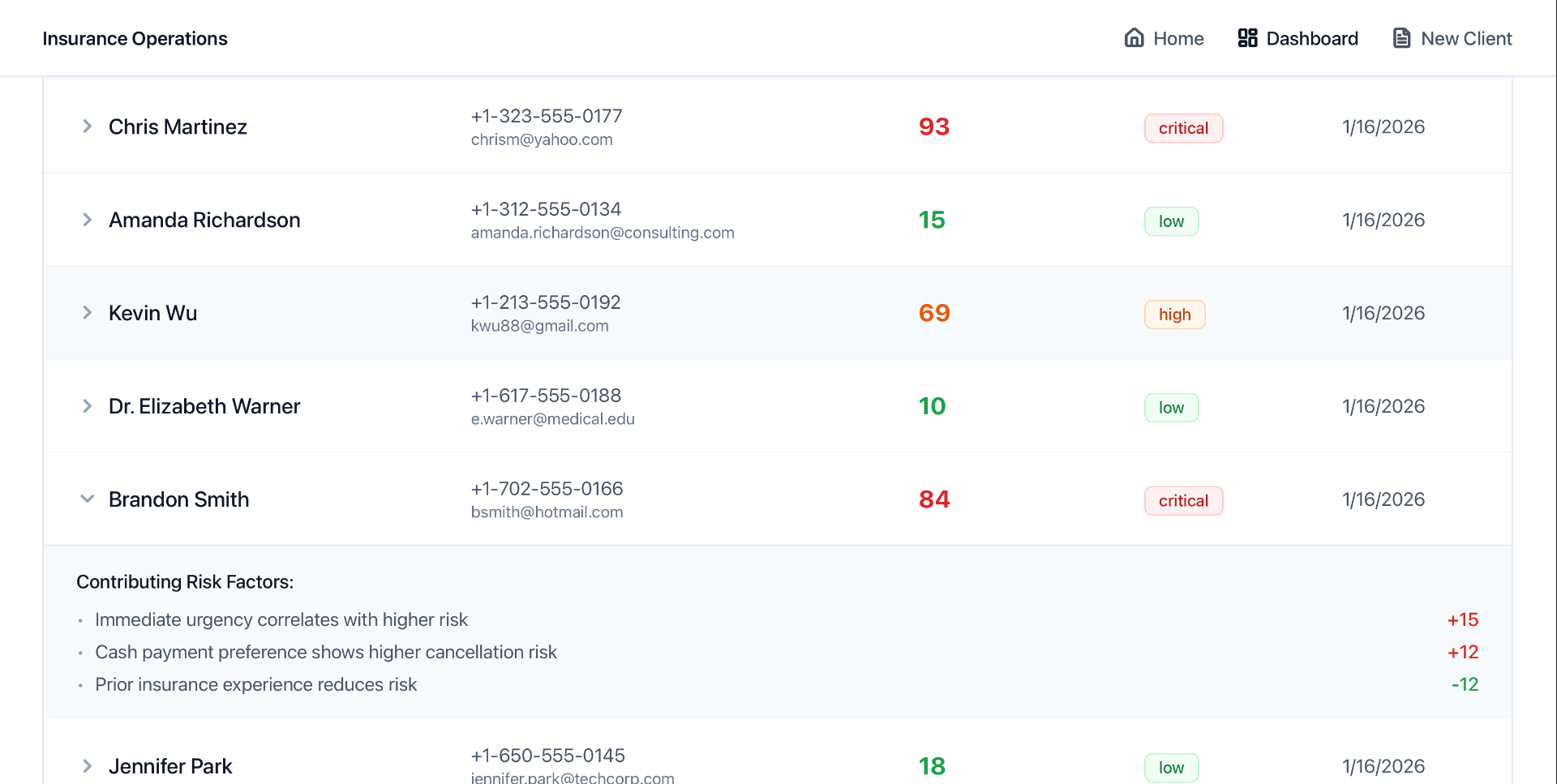
A client list with risk scores ranging from 10 (Low) to 93 (Critical). Expanding Brandon Smith's row (score 84, Critical) reveals the factor breakdown: immediate urgency +15, cash payment preference +12, prior experience -12.
Do you know on day one which clients will cost the most to serve?
We can assess your intake data and design risk scoring your ops team can see into, trust, and act on.
Explore a Similar System