Flight Delay Risk Predictor
The Problem
Airline operations centers manage delay risk after it materializes. A flight slips, and the OCC (operations control center) scrambles: rebook passengers, reassign gates, rework crew schedules. The signals that could have flagged the risk hours earlier — departure-time patterns, route complexity, load factors, weather — already sit inside the airline's own systems; they are just never synthesized into a decision before the disruption hits.
Where prediction models do exist, they tend to be black boxes. A number like "85% delay risk" with no explanation is not actionable — an ops manager cannot choose between extending a crew buffer and swapping a gate without knowing what is driving the risk.
Why It Matters Commercially
A significant delay rarely stays one delay. It cascades: gate conflicts, crew duty-time violations, missed connections, compensation claims, and the cost that never shows on an invoice — passenger trust. An OCC that can see risk two to three hours out makes structurally different decisions about crew buffers, gate assignments, and proactive rebooking, and spends less of its day paying for problems it could have priced in advance.
What We Built
A reference implementation of per-flight delay and cancellation risk scoring, built the way an OCC would actually use it: calibrated probabilities, explained factors, and a fleet-wide triage view.
For each flight, the system scores:
- •Delay probability as a calibrated percentage with a Low / Medium / High classification
- •Cancellation probability, scored separately — the drivers and base rates are different
- •Contributing factors with direction and magnitude: not "this flight is risky," but departure hour reducing risk by 6.9%, load factor raising it by 3.2%, weather severity contributing -0.7%
- •An FIDS (flight information display system) board showing every upcoming flight with delay and cancellation risk side by side, so duty managers put their attention where the schedule needs it
Attribution is what turns the score into an operational tool. "High delay risk" invites a shrug; "departure hour is the primary driver, load factor is compounding it, weather is neutral" invites a decision — extend the buffer, swap the gate, hold the connection.
Under the Hood
Per-flight parameters feed the model: flight number, scheduled departure hour, day of week, route type, load factor, weather severity index. A calibrated classifier (CalibratedClassifierCV wrapping LogisticRegression) produces probabilities that behave as probabilities — an ops manager acting on "70% delay risk" needs that number to mean 70%, not "high relative to other flights." Factor contributions come from perturbation analysis, a SHAP-style approach that measures how each input shifts the prediction.
The service layer is FastAPI with JWT-secured endpoints, stateless inference, and modular separation between the risk engine, service layer, and API surface. Endpoints cover per-flight scoring, factor explanation, cancellation risk, and the fleet-wide ops snapshot. Containerized and ready to deploy.
Outcome
A 2 to 3 hour forward-looking view on delay and cancellation risk for every upcoming flight, with actionable factor attribution. Duty managers stop reacting to delays after they happen and start making decisions before they hit. Crew buffers extended on the flights flagged as high-risk, gates reassigned proactively, connections held selectively rather than reactively. The class of decision changes from "scramble" to "triage."
The downstream effects compound. Fewer crew duty-time violations because buffers were added in advance. Fewer passenger compensation claims because rebooking happened before the missed connection. Fewer cascading delays through the daily schedule because high-risk flights got the attention they needed. Hard to quantify in the abstract, but operationally meaningful enough that several major carriers have already invested in internal versions of exactly this.
Where This Pattern Applies
Calibrated risk plus explained factors is a portable architecture for any scheduled operation where failures are costly and the warning signs live in operational data. Logistics networks scoring shipments for ETA risk before the customer feels it. Field-service operators flagging the appointments most likely to overrun. Port and ground-handling teams triaging berths and gates. Hospitals anticipating theatre overruns and bed bottlenecks. Wherever a dispatcher allocates scarce resources from experience alone, calibrated scores with explanations turn that experience into decisions made hours earlier.
See It in Action
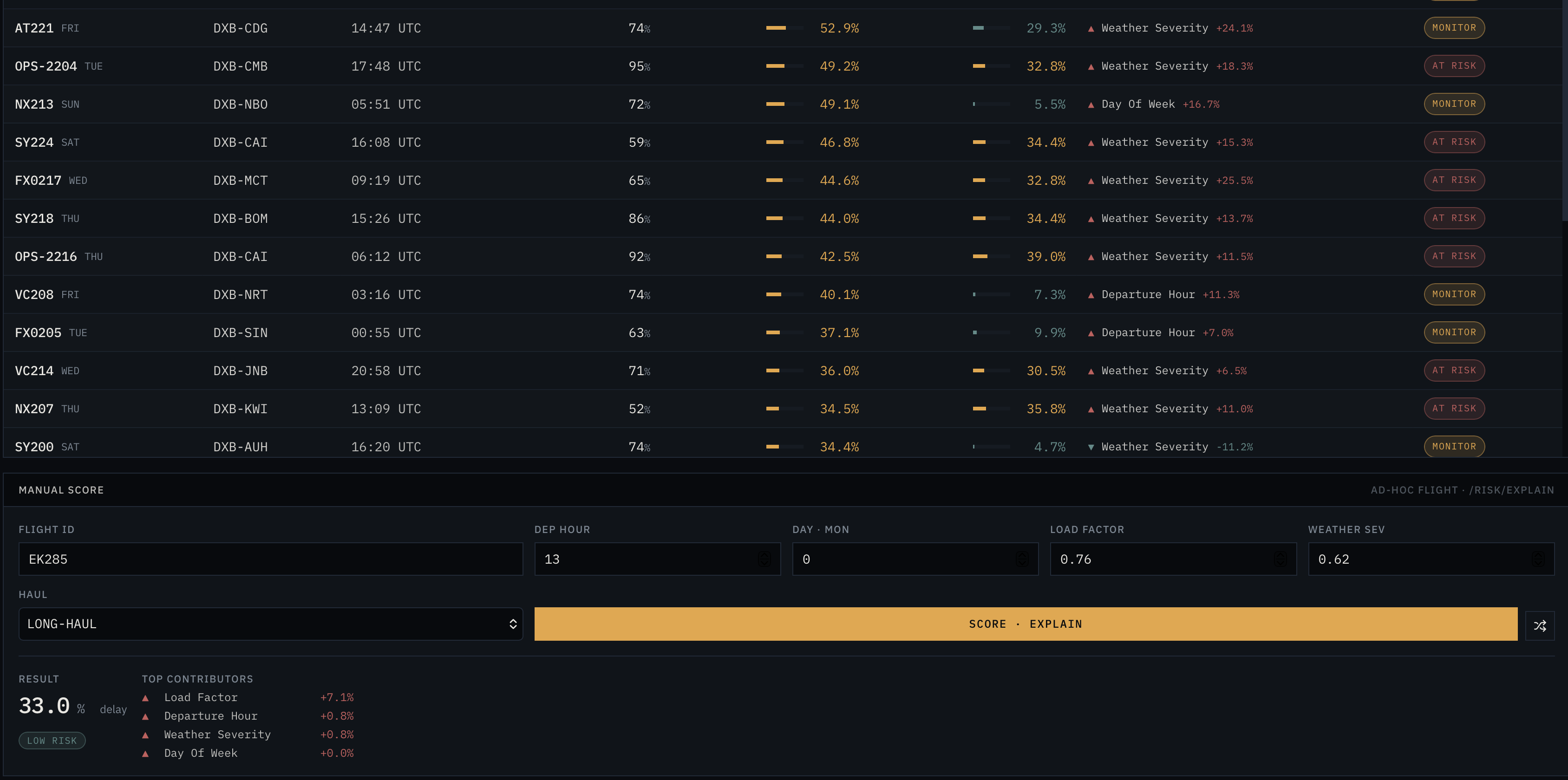
FIDS-style view with at-risk / monitor flags on every upcoming flight, plus an ad-hoc scoring panel returning a calibrated 33.0% delay risk for EK285 with factor attribution: load factor +7.1%, departure hour +0.8%, weather severity +0.8%.
Which disruptions could your operation see coming?
We can assess where calibrated, explainable risk scoring fits your operation and implement it on the data your systems already produce.
Explore a Similar System