Portfolio Agent — LLM-Powered Portfolio Optimization
The Problem
A financial advisor's revenue comes from relationships, but the week goes to portfolio mechanics. The available tooling sits at two unhelpful extremes: model portfolios that ignore an individual client's constraints, and institutional-grade optimizers that need a quant to operate. Neither produces the thing the advisor actually sends — an explanation the client can read.
Why It Matters Commercially
Run the arithmetic on a review cycle: building the allocation, computing risk metrics, stress-testing scenarios, then translating all of it into plain language is half a day per client. Across a book of 50 to 100 clients, the math doesn't work — reviews get shallower, less frequent, or handed to a model portfolio that was never really about this client. The constraint on the practice is not investment skill; it is explanation time.
What We Built
A portfolio agent that runs the optimization and writes the explanation in one step. The advisor sets the inputs; the system returns both the quantitative work and a client-ready narrative.
The system handles:
- •Portfolio optimization: input tickers, choose an objective — Max Sharpe, Min Variance, and others — set constraints such as maximum weight per asset and risk tolerance, and the agent computes optimal weights from historical data over a configurable lookback window
- •Risk metrics computed automatically: standard deviation, Sharpe ratio, expected return, and drawdown analysis
- •Scenario behavior: how the allocation holds up under different market conditions
- •A client-ready explanation generated by an LLM from the actual optimization output: why each position is weighted as it is and what the risk profile means in practice, written for an engaged client rather than a quant
Optimizers exist. What most advisory practices lack is the step after the optimizer — the one that turns its output into the client email. That is the gap this closes.
How It Works
Enter tickers, set constraints — risk-free rate, maximum weight per asset, risk tolerance, lookback period — and select an optimization objective. The agent optimizes, computes risk and scenario analysis, and drafts the client explanation. One input, full output: numbers the advisor can verify, language the client can understand.
Where This Pattern Applies
The optimize-then-explain pattern fits any business where a quantitative engine produces answers a non-quantitative audience has to accept. Lenders explaining credit decisions to applicants and regulators. Insurance teams translating pricing models for brokers. Procurement groups justifying supplier scores. Fund administrators turning performance data into investor letters. The engine differs each time; the commercial value is the same — analysis that arrives already explained.
See It in Action
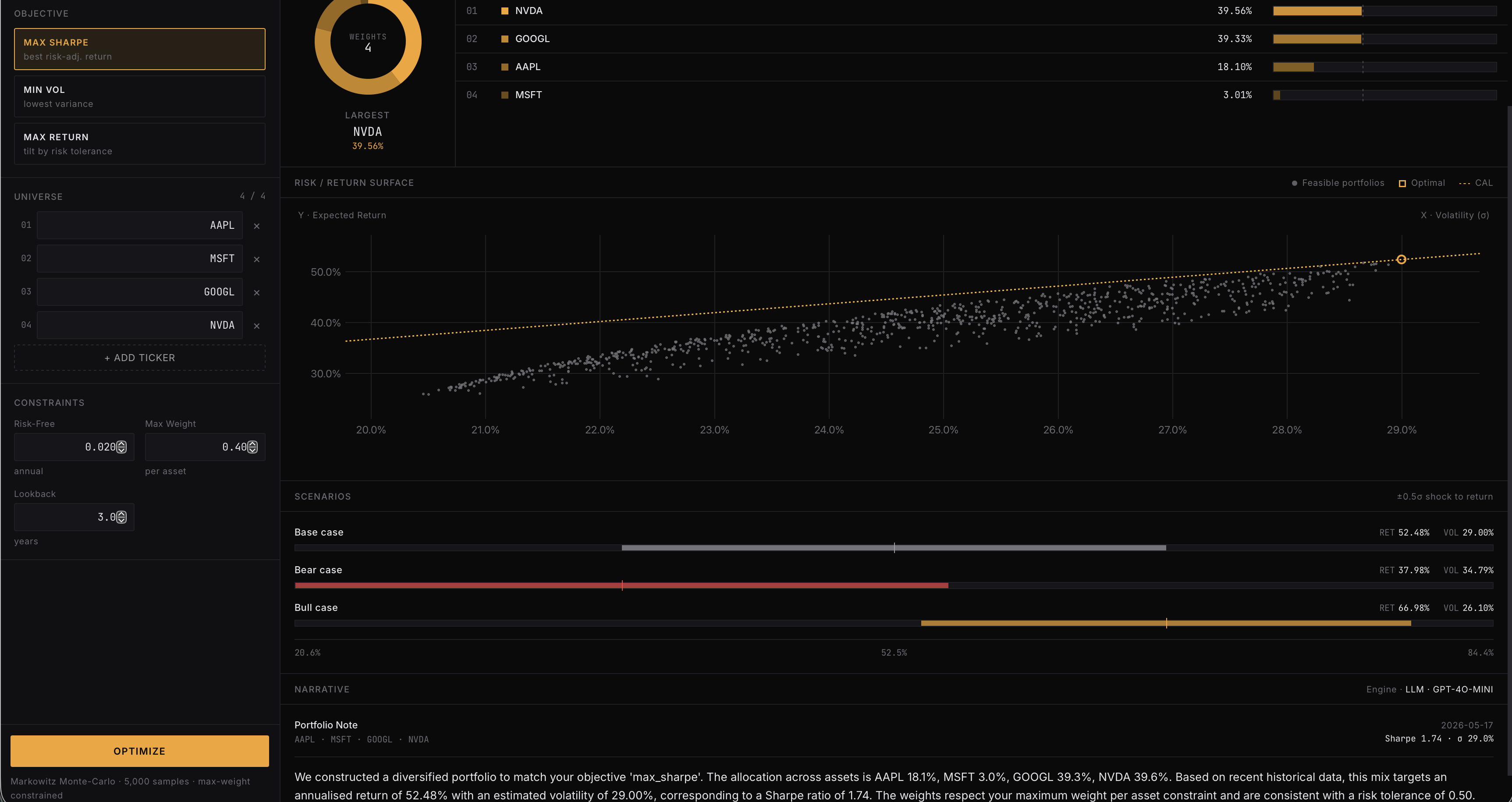
A four-asset Max Sharpe portfolio (AAPL, MSFT, GOOGL, NVDA) under a 0.40 max-weight constraint and 3-year lookback — Sharpe 1.74, 52.48% annualised return at 29.00% volatility, with bull/base/bear scenarios and an LLM-generated client narrative.
How many client reviews does your week actually have room for?
We can map where your practice's analysis waits on explanation and implement a system that delivers both in one step.
Explore a Similar System